
Fabric insight
What Is Air Permeability in Fabric? A Guide for Windproof Jacket Buyers
Air permeability helps buyers evaluate how easily air passes through a jacket fabric, but “windproof” is not a complete specification. Test method, limit, finished construction and garment comfort all need to be considered together.
When a buyer asks for a **windproof fabric for jackets**, the specification sometimes contains only one word:
“Windproof.”
For fabric development, that is not enough.
A fabric may feel highly wind resistant in the hand, but a supplier and buyer still need an objective way to confirm its performance.
This is where **air permeability in fabric** becomes important.
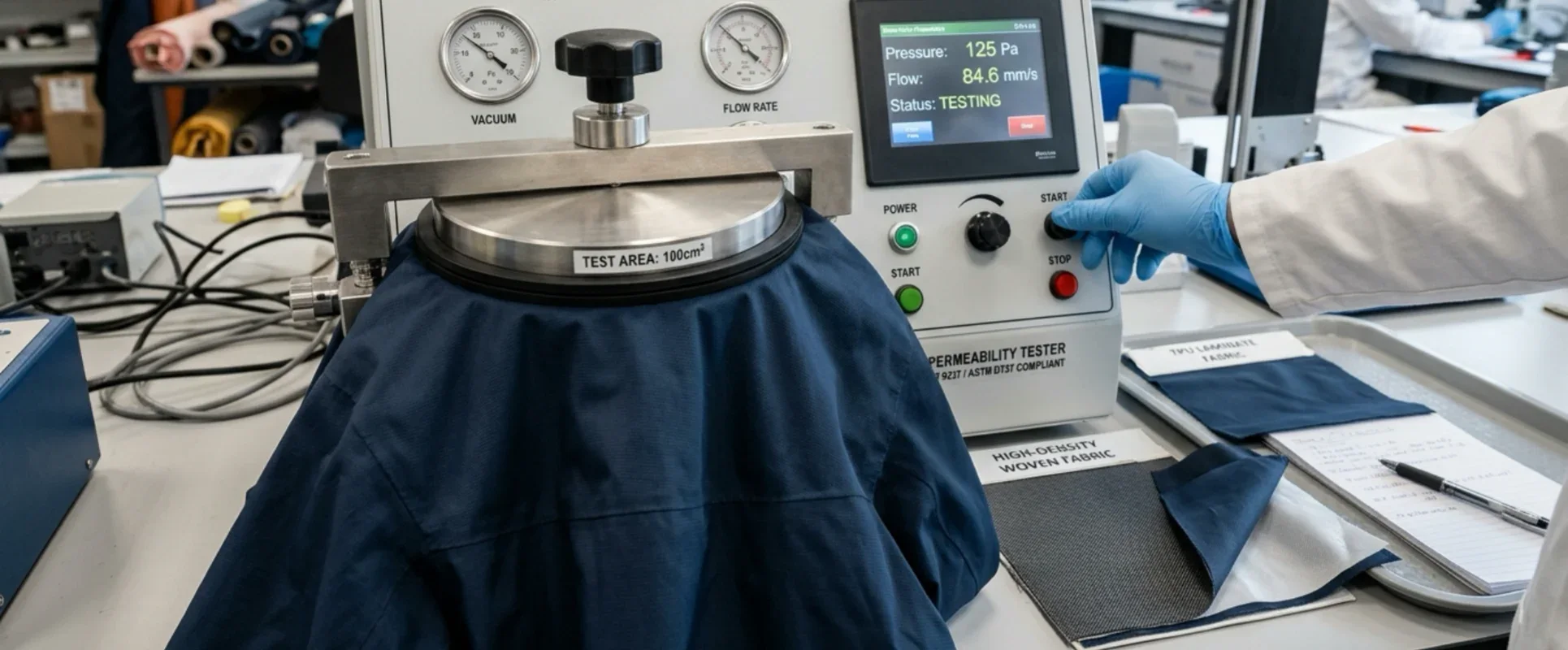
Air permeability testing measures how readily air passes through a textile under defined test conditions.
For outdoor jacket fabrics, the result can help buyers evaluate whether the construction provides the level of wind resistance required for the intended garment.
However, a very low air permeability result does not automatically mean that the fabric is the best choice.
The final jacket still needs to balance wind protection with factors such as comfort, finished weight, hand feel, coating or lamination structure, moisture management and garment ventilation.
At CC Textile, we use air permeability testing in outdoor fabric projects when wind resistance needs to be confirmed. The test method and acceptance limit are determined according to the customer's specification rather than by applying one universal “windproof” value to every jacket fabric.
What Does Air Permeability Measure?
Air permeability describes the amount of air that can pass through a fabric under specified testing conditions.
In practical terms, the test creates a pressure difference across the fabric and measures the airflow passing through it.
For a woven jacket fabric, the result is influenced by the open spaces within the textile structure.
These spaces can be affected by:
- yarn size
- warp and weft density
- weave construction
- yarn shape and filament structure
- calendaring
- coating
- lamination
- mechanical finishing
- chemical finishing
A loosely constructed woven fabric generally allows more air movement than a tightly constructed fabric made from a comparable yarn system.
But the comparison becomes much more complicated once finishing, coating or membrane lamination is introduced.
This is why an air permeability value should always be read together with the complete fabric specification.
It should not be treated as an isolated number.
Why “Windproof Fabric” Needs a Test Method and Limit
“Windproof” is a useful product description.
It is not, by itself, a complete laboratory specification.
If a buyer writes only:
“Fabric must be windproof,”
several important questions remain unanswered.
Which air permeability test method will be used?
What test conditions apply?
What unit will be reported?
What is the acceptable limit?
Should the test be carried out on the base fabric or the completely finished fabric?
Does the requirement apply before or after coating or lamination?
These details matter because a numerical result only has meaning when the testing conditions are also known.
A buyer may receive two reports from different suppliers showing different values, but those numbers should not automatically be compared unless the test methods and conditions are equivalent.
For sourcing and bulk production approval, it is therefore much clearer to specify:
**Test method + test conditions + unit + acceptance limit + fabric stage to be tested.**
At CC Textile, when a customer provides a specified testing method and limit, we use those requirements to evaluate the fabric rather than replacing them with our own arbitrary definition of windproof performance.
You can read more about our approach to testing and production control in Quality & Compliance.
Air Permeability Is Not the Same as MVTR
Air permeability and moisture vapour transmission are often discussed together when buyers evaluate an outdoor jacket.
But they measure different things.
**Air permeability measures airflow through the fabric.**
**MVTR relates to the transmission of water vapour through a material or fabric system.**
A fabric can therefore have very low air permeability while still being designed to allow water vapour transmission through a breathable membrane.
This is common in waterproof and wind-resistant shell constructions.
For example, a laminated jacket fabric may be designed to restrict the movement of outside air while allowing moisture vapour generated by the wearer to pass through the membrane system.
That does not mean the two properties are unrelated to wearer comfort.
It means they should not be confused as the same test.
This distinction is particularly important when buyers use the word “breathability”.
In commercial discussions, “breathable” may refer to several different aspects of comfort.
It can refer to moisture vapour transmission.
It can refer to actual airflow.
It can also be used more generally to describe how comfortable the finished garment feels during activity.
These are not always the same thing.
A buyer comparing **air permeability vs breathability** should therefore confirm which physical property is actually being specified.
For waterproof shells, moisture build-up inside a jacket can also be affected by garment construction, activity level, weather conditions and ventilation.
We discuss this in more detail in Why Waterproof Jackets Feel Wet Inside.
How Weave Density, Coating and Lamination Affect Airflow
For woven outdoor fabrics, the base construction already has a major effect on airflow.
### Weave density
If warp and weft yarns are packed more closely together, the spaces available for air to pass through the fabric can become smaller.
This is one reason high-density woven constructions are frequently considered for wind-resistant jackets.
However, density cannot be evaluated independently from yarn size and weave.
A fine-denier, high-density fabric can behave very differently from a heavier fabric using a completely different construction.
The finished GSM may also be different.
So simply saying “high density” still does not provide a complete windproof specification.
### Calendaring
Calendaring can change the surface and internal structure of a woven fabric.
Depending on the construction and process, it can make the fabric surface more compact and reduce the available paths for air movement.
This can be useful for some lightweight jacket constructions.
But buyers should still evaluate the finished hand feel, appearance and other required performance.
### PU coating
Adding a PU coating can significantly change how air moves through the fabric.
Once coated, the result is no longer determined only by the woven base.
The coating formulation, coating amount and application process can all affect the final performance.
The fabric may become more wind resistant, but coating can also affect:
- hand feel
- stiffness
- finished GSM
- drape
- air permeability
- moisture management
For this reason, testing only the uncoated base fabric may not represent the performance of the finished jacket fabric.
### TPU lamination
A TPU membrane can change the airflow characteristics even more significantly.
In a laminated construction, the buyer is evaluating a composite rather than an individual woven face fabric.
For example:
Face fabric / TPU membrane
or:
Face fabric / TPU membrane / backing fabric
The air permeability result of the final laminate may be very different from that of the face fabric before lamination.
This is why we normally need to know the final construction before judging whether an air permeability result is relevant.
The same principle applies to waterproof specifications.
A base fabric should not be confused with the performance of the complete finished system.
You can find more discussion about complete waterproof constructions in Waterproof Fabric Specifications.
Can Air Permeability Be Too Low?
For a highly wind-resistant jacket, very low airflow may sound like the ideal result.
Sometimes it is exactly what the product requires.
But lower is not automatically better for every jacket.
The correct result depends on the intended garment.
Consider two very different products.
A technical shell designed for strong wind and exposed weather may prioritise extremely limited air movement through the fabric.
A lightweight active jacket intended for running or high-output hiking may require a different balance between wind resistance and wearer comfort.
This does not mean that the second fabric should simply have “high air permeability”.
It means the performance specification should reflect the actual use of the garment.
Comfort also depends on more than the face fabric alone.
The finished garment may include:
- front zips
- pit zips
- mesh-lined pockets
- ventilation openings
- loose or fitted pattern construction
- different lining structures
All of these can influence how heat and moisture are managed during wear.
So an extremely low air permeability value should not be used as a complete prediction of garment comfort.
It tells us something important about airflow through the tested material.
It does not tell us everything about the finished jacket.
Why Testing Must Use the Finished Fabric
One of the most important sourcing questions is:
**At what stage was the fabric tested?**
A buyer may receive an air permeability report for a base woven fabric.
But the production fabric may later receive:
- DWR finishing
- calendaring
- PU coating
- TPU lamination
- backing fabric lamination
- other mechanical or chemical finishing
Any of these processes can change the final result.
This is especially important for laminated technical fabrics.
Suppose a face fabric has an acceptable air permeability result before lamination.
After adding a membrane and backing layer, the construction becomes a different material system.
The original result no longer describes the complete finished product.
For bulk production approval, the test stage should therefore match the specification agreed with the buyer.
If the requirement is for the finished laminated jacket fabric, the final laminate should be tested.
The same principle applies when comparing development samples.
One unfinished sample and one fully finished sample should not be treated as equivalent simply because the yarn specification and fibre content are similar.
For new constructions, our Fabric Development process can include evaluation of the final finishing or lamination route before the fabric specification is confirmed.
What Buyers Should Include in a Windproof Fabric Specification
A clear specification makes development much easier for both buyer and supplier.
Instead of writing only:
“Windproof fabric required,”
we recommend defining the following information.
### 1. Garment application
State the intended use.
For example:
- hiking shell
- windbreaker
- running jacket
- ski jacket
- rain jacket
- softshell
- workwear jacket
This helps the supplier understand how wind resistance fits into the complete performance requirement.
### 2. Fabric construction
Where known, include:
- fibre composition
- yarn denier
- weave
- finished GSM
- stretch requirement
If these are not yet confirmed, provide a reference sample or finished garment target.
### 3. Air permeability test method
Specify which method is required.
This prevents different suppliers from testing under different conditions and then comparing results that may not be directly equivalent.
### 4. Acceptance limit
If your company or brand has a required air permeability limit, include it in the specification.
Do not rely only on the word “windproof”.
### 5. Reporting unit and test conditions
Make sure the reporting format is clearly defined.
The number should always be understood together with the conditions under which it was measured.
### 6. Fabric stage
Specify whether testing applies to:
- untreated base fabric
- finished fabric
- PU-coated fabric
- 2-layer laminate
- 2.5-layer laminate
- 3-layer laminate
This avoids approving one construction and testing another.
### 7. Other required performance
Air permeability is normally only one part of an outdoor fabric specification.
The project may also require:
- hydrostatic pressure
- MVTR or another moisture vapour test
- tear strength
- abrasion resistance
- stretch and recovery
- DWR performance
- dimensional stability
- washing durability
These requirements need to work together.
A fabric should not pass one test while becoming unsuitable for the actual garment.
Windproof Is a Performance Requirement, Not Just a Description
Air permeability is a useful way to evaluate airflow through a textile.
For windproof outdoor jackets, however, the test result should always be placed in context.
The buyer needs to know:
**what was tested, how it was tested, at what stage it was tested and what limit the fabric is expected to meet.**
There is no reason to force every outdoor jacket into one universal air permeability number.
A lightweight windbreaker, an active hiking jacket and a laminated technical shell may require different performance balances.
The correct specification starts with the garment.
From there, the fabric construction, finishing and test requirements can be developed around the intended use.
At CC Textile, air permeability can be evaluated as part of an outdoor fabric development programme when wind resistance is required.
If your project already has a specified test method and acceptance limit, you can provide those requirements together with the garment type, GSM, construction and finishing details.
If the specification is still being developed, we can compare suitable constructions and determine which samples should move into performance testing.
Buyers researching the wider technical textile supply chain can also visit Tex-Alliance.
You can also follow CC Textile on Instagram for outdoor fabric development, testing and woven textile updates.
#AirPermeability #WindproofFabric #OutdoorTextiles #FabricTesting #PerformanceWoven
Frequently Asked Questions
What is air permeability in fabric?
Air permeability measures how readily air passes through a fabric under specified test conditions. For outdoor jacket fabrics, it can help buyers evaluate wind resistance, but the result should always be considered together with the test method, fabric construction and finished processing stage.
Does low air permeability mean a fabric is windproof?
Low air permeability generally indicates limited airflow through the tested fabric, but “windproof” should not be defined by one universal value. Buyers should specify the test method, conditions, reporting unit, acceptance limit and whether the requirement applies to the finished fabric.
Is air permeability the same as fabric breathability?
No. Air permeability measures airflow through a fabric, while moisture vapour tests such as MVTR evaluate water vapour transmission. Both can influence wearer comfort, but they describe different physical properties and should not be treated as the same specification.
Should air permeability be tested before or after coating and lamination?
The test stage should match the buyer’s specification. If the requirement applies to a finished PU-coated or TPU-laminated jacket fabric, the completed construction should be tested because coating, membrane lamination and other finishing processes can significantly change airflow.