
Fabric insight
Why DWR Fails After Washing: What Fabric Buyers Should Know
An initial spray rating does not establish wash durability. This guide examines C0 DWR selection, application control and washing specifications, including a 70D nylon project with an initial AATCC 22 rating of 90 and at least 80 after 20 washes and prescribed drying.
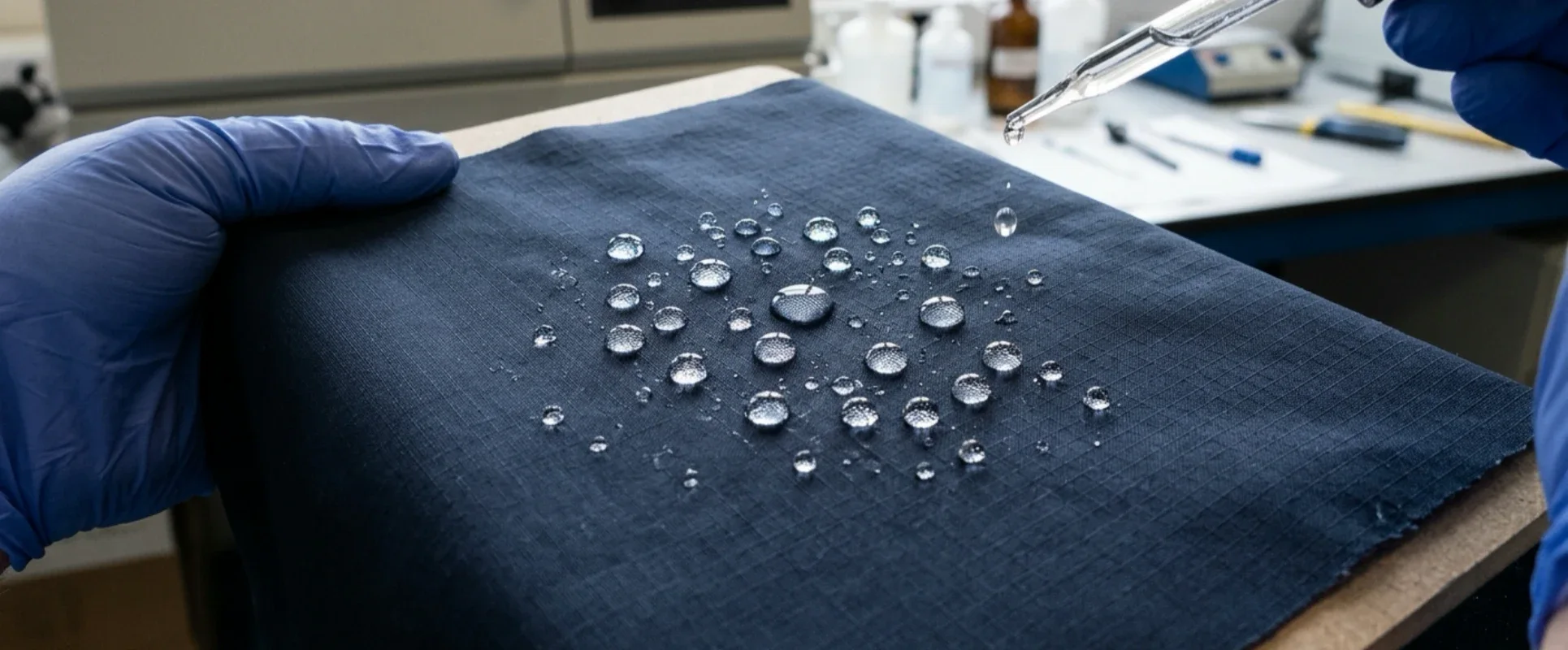
A fabric can bead water well when new and still fail its water-repellency requirement after washing. An unsuitable finishing agent or application level can contribute to this gap. However, a lower spray rating alone does not identify the cause: the washing programme, drying procedure and sample condition also need to be checked.
For buyers evaluating DWR after washing, the useful question is not simply, “Does this fabric repel water?”
It is, “What performance remains after 10 or 20 washes under the care conditions agreed for this garment?”
This is not an argument against washing outdoor clothing. It is a reason to develop and approve the durable water-repellent finish against the care routine the garment is expected to follow.
1. Initial DWR Is Only the First Check
Water beading on a development sample is useful evidence of its current surface behaviour. It is not evidence of wash durability.
A request that says “C0 DWR, spray rating 90” leaves an important question unanswered: is 90 required before washing, after washing, or both?
AATCC TM22, Water Repellency: Spray Test assesses resistance to surface wetting under controlled spray conditions. The resulting wetting pattern is compared with the method’s evaluation scale.
The rating is not a waterproof percentage. An AATCC 22 result of 90 does not mean that a fabric is “90% waterproof.”
The spray test also does not, by itself, define the laundering programme used before assessment. Washing and drying conditions must be specified separately.
For sourcing teams, this creates a familiar approval risk. An initial sample is accepted because water beads on the surface, but the wash requirement is only checked later. A failure at that stage can delay fabric approval, garment sampling or bulk production.
Initial rating + wash cycles + after-wash target should therefore be agreed before the finishing route is approved.
2. C0 DWR vs Traditional Fluorinated DWR
C0 is commonly used as a commercial description for a non-fluorinated water-repellent finishing route. Traditional fluorinated DWR uses fluorinated chemistry.
For a fabric buyer, the practical difference is not explained by these labels alone.
Neither “C0” nor “fluorinated DWR” specifies how a particular finished fabric will perform after 20 washes. A change in finishing chemistry requires its own development and validation; an existing recipe or approval should not simply be carried over.
Buyers should separate three requirements.
Water repellency
Define the spray-test method, initial rating and required result after washing. C0 DWR durability must be evaluated on the actual fabric, not inferred from the finish name.
Other performance requirements
Do not assume that a water-repellent finish also provides oil repellency or stain resistance. If those properties are required, they need separate specifications and supporting tests.
PFAS requirements
A request for “non-PFAS DWR fabric” needs a defined scope. Where the project requires no intentionally added PFAS, specify that requirement alongside chemical documentation, production controls and any laboratory verification.
C0 is not a certificate proving that every component of the finished fabric is free from every PFAS substance. Likewise, an ND result applies to the tested sample, substances, method and detection or reporting limits; it is not proof of absolute zero.
Our PFAS control information explains how these requirements can be handled at project level.
The purchasing decision should therefore cover both chemical requirements and measured wash durability. One does not replace the other.
3. Why Water Repellency Drops After Washing
In CC Textile’s development work, unsuitable finishing-agent selection or dosage has been identified in projects that did not meet after-wash water-repellency targets.
These are practical production issues, but they should not be assumed to explain every failed sample.
Finishing-agent selection
An agent that produces an acceptable initial spray rating is not automatically suitable for the required wash durability on that fabric.
The development trial needs to connect the selected finish with the actual fabric construction, application route and after-wash target. Approval based only on an initial result leaves that relationship untested.
Application level
The amount of finishing agent used must be appropriate for the selected product and process. An unsuitable application level can leave the finished fabric short of its wash-durability requirement.
That does not mean “more chemical is always better.” Dosage changes should follow the selected agent’s technical guidance and be validated on the finished fabric.
A failed wash test is a reason to review the application record and repeat the relevant trial, not simply to increase the amount without further assessment.
Comparable test conditions
Before deciding why DWR stops working, confirm that the samples were evaluated under comparable conditions.
Was the same washing procedure used? Was the detergent the same? Was the fabric assessed after the specified drying step? Was any additional heat treatment or reproofing included?
ISO 6330 provides domestic washing and drying procedures for textile testing. It includes different procedure options, so quoting the standard number alone may still leave important details undefined.
A result after prescribed heated drying should not be presented as though it were obtained after air drying. Both the treatment history and the assessment condition belong in the report.
4. Why Summer Production Can Be Difficult: A 70D Nylon Case
A European customer’s lightweight-jacket project provides a useful example of why actual production conditions matter.
The fabric was a 70D nylon woven material at approximately 110 GSM, developed with a C0 DWR finish.
During hot summer production conditions, the water-repellent result was unsatisfactory. The production team responded by adding ice directly to the DWR working liquid to lower its temperature.
Because the melting ice also added water, the team separately added finishing agent to adjust the concentration.
Following these adjustments, the evaluated fabric achieved:
• Initial AATCC 22 spray rating: 90
• AATCC 22 spray rating after 20 washes: not less than 80
• Post-wash preparation: prescribed heated drying before assessment
These results relate to that project and its washing and drying conditions. They are not a fixed specification for every 70D nylon fabric or every C0 DWR finish.
The lesson is not that adding ice is a standard solution for water-repellent finishing.
Temperature management and concentration adjustment were both part of the production response. The outcome should not be reduced to a claim that cooling alone produced the final performance.
For another finishing agent, fabric or production line, the suitable operating conditions may be different. Any temperature adjustment needs to stay within the validated process and account for changes to the working liquid.
For buyers, the useful question is whether the finishing team can control the actual production conditions and verify the resulting fabric. A recipe name and an initial spray rating do not show that by themselves.
5. DWR Is Not Waterproof
DWR helps the fabric surface resist wetting. It does not, by itself, establish resistance to water penetration under pressure.
When water stops beading and spreads across the face fabric, the surface may be wetting out. That does not automatically mean that an underlying membrane has failed.
Equally, a high spray rating does not prove that a fabric is suitable for a waterproof rain jacket.
Waterproof performance needs separate evidence for the relevant coating or membrane construction, hydrostatic-pressure requirement and finished-garment details such as seams, tape and closures.
A DWR-treated lightweight-jacket fabric should be described as water-repellent unless additional construction and testing support a waterproof claim.
This distinction matters when investigating a complaint. A wet face fabric and water entering through an incompletely taped seam require different checks. Our article on why ski jackets fail explains these failure points in more detail.
The 70D nylon case above demonstrates project-specific surface water repellency after washing. Its spray results are not a hydrostatic-head rating.
6. What Buyers Should Put on the Specification
A useful DWR specification tells the supplier what must be achieved and tells the laboratory how to assess it.
Before approving water-repellent fabric after washing, confirm the following.
• Fabric identity: composition, construction, yarn specification, GSM, colour and sample or lot reference
• Finishing requirement: the selected C0 DWR route and any separate chemical restrictions
• Spray-test method: including the method version required by the customer
• Initial target: the minimum acceptable rating before washing
• Wash durability: the required number of wash cycles and minimum rating afterwards
• Laundering procedure: the method, procedure designation, washing temperature and detergent
• Drying procedure: the drying method, temperature and duration, plus any separately permitted heat treatment
• Retreatment policy: whether reproofing is excluded or is being assessed as a separate maintenance procedure
• Assessment and acceptance: specimen conditioning, sampling plan, laboratory and acceptance criteria
• Bulk verification: which production samples will be checked and when testing is required
Reproofing and wash durability should not be confused. A result measured after applying additional water-repellent treatment describes a different evaluation from a result measured without that treatment.
The drying procedure should also be compatible with the intended garment care instructions. If the test requires a drying step that the finished garment cannot tolerate, the specification needs to be reviewed.
A practical RFQ starting point
The following example uses the performance level confirmed for the nylon case. It is a development brief, not a universal product guarantee:
Fabric: 70D nylon woven fabric, approximately 110 GSM, for a lightweight jacket.
Finish: C0 DWR, with any no intentionally added PFAS requirement specified separately.
Spray test: AATCC 22, agreed method version.
Initial requirement: minimum rating 90.
After-wash requirement: minimum rating 80 after 20 washes and the agreed heated-drying procedure.
Laundry details: washing method, programme, temperature, detergent, drying schedule and any additional treatment to be confirmed before testing.
Verification: representative finished-fabric samples, with the laboratory and bulk sampling plan agreed before production.
For a coated or laminated shell, add the separate waterproof and moisture-transfer requirements rather than expecting the DWR specification to cover them. Our waterproof fabric specification checklist covers those additional parameters.
The purchasing principle is straightforward: approve DWR on its defined after-wash performance, not only on water beading from a new sample.
If you have a reference fabric, failed wash-test report or target care requirement, contact CC Textile to discuss sample-based development and an appropriate verification plan. You can also connect with CC Textile on Facebook.
Frequently Asked Questions
Why does DWR stop working after washing?
An unsuitable finishing agent or application level can contribute to inadequate wash durability. Before assigning a cause, check the washing, drying and assessment conditions. A lower spray rating alone does not identify the production problem.
Can C0 DWR remain water-repellent after 20 washes?
Yes, on a validated fabric and finishing route. In one CC Textile 70D nylon project, the AATCC 22 rating was 90 initially and at least 80 after 20 washes and prescribed heated drying. This is a project-specific result, not a universal C0 DWR specification.
Does the drying method matter when testing DWR after washing?
Yes. Report the drying method and any additional heat treatment. Results after prescribed heated drying should not be treated as equivalent to air-dried results. The test procedure should also be compatible with the intended garment care instructions.
Does a lower DWR spray rating mean the fabric is no longer waterproof?
Not necessarily. Spray ratings assess surface wetting, while hydrostatic-pressure testing assesses resistance to water penetration. Face-fabric wet-out can occur without membrane leakage, and a high spray rating alone does not establish waterproof performance.